
Fairborn Historical Directory Collections
The historical shelf for a Fairborn directory is centered at the Greene County Room in Xenia Community Library. The library confirms directories reaching to 1870, but does not publish a complete title-by-title or Fairborn-only run online. That limit matters. It is accurate to request a year, locality, or surname from the collection; it is not accurate to promise a particular publisher or an unbroken run. The Room also has a physical catalog and local-history assistance. Fairborn municipal files are a different route and do not create a historical name-and-address directory.
| Collection | Years | Where Held | Access |
|---|---|---|---|
| Fairborn-area historical directories | To 1870 | Greene County Room, Xenia Community Library | Physical catalog and onsite local-history help |
| Fairborn directory and criss-cross information | Year coverage not fully published | Greene County Room reference service | Onsite inquiry or limited staff assistance |
| Fairborn local digital collection | Selected records | Greene County Public Library | Online, collection-specific access |
| Fairborn Archives catalog and map records | Collection-specific | Greene County Records Center & Archives | Catalog, reading room, or research request |
Materials do not circulate, and archives material needs staff assistance. The library policy allows limited help with letter requests and generally lists photocopies at 25 cents per page. Fairborn researchers should use a year and locality in a request, then ask about the Fairborn, Fairfield, or Osborn volume or microfilm access for that exact lead.
Fairborn Historical Directory Shelf Access
The Greene County Room is inside Xenia Community Library, rather than the Fairborn branch. Its published hours are Monday through Saturday, noon to 5 p.m., and its phone number is (937) 736-7140. It offers directory and criss-cross information as a named reference category for Fairborn work. The same local-history channel supplies in-library access to Ancestry Library Edition, where available databases can include census, vital, directory, and photograph material. That licensed access is available at library locations, not as a promise of remote access from Fairborn or elsewhere.
The Greene County Room collection overview confirms two useful scale markers: historic newspaper microfilm reaches to 1814, while directories reach to 1870. Those dates describe the historical collection, not a guarantee that each title or year is digitized. A careful request names the person, approximate year, and every likely locality label.
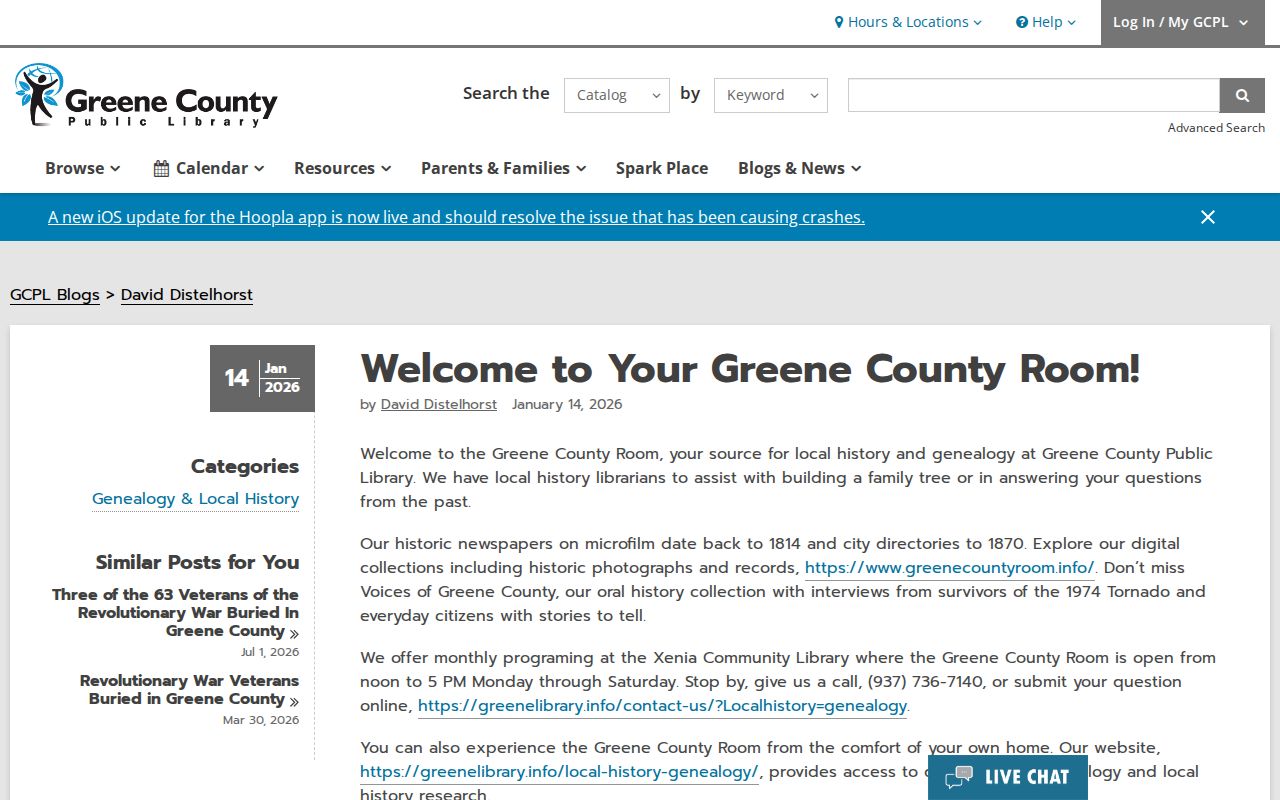
The collection view supports beginning with the library shelf or staff route when a historic directory is needed.
Read a Fairborn Historical Directory Entry
No citable digital viewer supplied a specific Fairborn, Fairfield, or Osborn directory page for this research. A reliable Fairborn directory transcription therefore starts with what is printed, rather than filling in fields a volume may not contain. Photograph or note the title page before copying a name. Keep initials, suffixes, spelling, locality, and street line exactly as they appear. If a directory includes a spouse, widow, telephone, trade, or other notation, record it only when it is visible. Do not turn a listed Fairborn person into proof of everyone in a household.
| Title-page facts | Locality, publisher, edition, year, and holdings or call number. |
|---|---|
| Printed name | Initials, title, suffix, spelling, and surname exactly as shown. |
| Street line | Number and street as printed, checked against a map from the same period. |
| Other notation | Any spouse, widow, telephone, or reference mark that the opened volume actually shows. |
| Reverse listing | Street heading, number, listed surname or initial, and edition year. |
- Criss-cross directory
- The street-order portion of a directory that moves from an address to a listed name. It is an address clue, not a complete household count.
- Householder index
- An index arranged around a named household or listing unit. Its scope depends on the printed volume.
- Abbreviation key
- The volume's own explanation of shortened words and marks. Capture it before expanding any shorthand.
Fairborn Historical Directory Names
Historic directory work in Fairborn needs three place names. Original Osborn stood in a flood-prone basin, moved after the March 1913 flood and Huffman Dam work, and later joined Fairfield in 1950 to form Fairborn. A pre-1950 Fairborn search under the modern name alone can miss the appropriate listing. Search Fairborn after the merger, then add Fairfield, Osborn, and Osborn-Fairfield for earlier years. A Fairborn name or street change may reflect the community's relocation and merger rather than a move by the person being traced.
The Greene County Archives programs route supports the Fairborn, Fairfield, and Osborn historical context. Use it with the directory date, not as a substitute for the volume itself.
The archives material is useful when an old directory heading uses a predecessor community instead of the modern Fairborn name.
Trace Fairborn Directory Households
A Fairborn household trail is stronger when each directory result is paired with another record family. Start with a present-day Fairborn parcel or legal description from county sources, rather than trusting an online map pin. The Recorder's web index begins in 1984, so older document work continues through the Recorder counter and Archives indexes. For Fairborn directory years, retain the printed spelling and address, then use maps and census records to test whether the older place is the same physical area. The most recently public federal decennial census is 1950, and schedules after 1850 list household names.
- Write down the Fairborn address, parcel identifier, or legal description that anchors the search.
- Select the directory year and search Fairborn, Fairfield, Osborn, and surname variants that fit that period.
- Copy the Fairborn printed entry and volume key without normalizing spelling or abbreviations.
- Check a Fairborn criss-cross page, if present, for the street and listed name in that edition.
- Compare the Fairborn address with a dated map, legal description, or plat before treating it as the same place.
- Pair the Fairborn directory year with the nearest census, newspaper, cemetery source, probate record, or family file.
A disappearance from one volume can mean several things: a move, a changed listing form, a predecessor-place heading, a gap in the collection, or no listing. The county historic-property materials connect directories with maps, census, obituaries, estates, cemeteries, and family files. Each source adds a separate fact, not a final conclusion by itself.
Note: A directory listing is a historical lead and should be checked against a dated map or another original record before relying on it.
Fairborn Directory Map Dates
The county map inventory gives Fairborn directory research a rare date-by-date bridge. It includes an Osborn/Fairfield Bath Township map from 1922; Fairfield maps from 1925, 1934, and 1948; Osborn maps from 1934, 1942, and 1948; and Fairborn maps beginning in 1950, plus later Fairborn and Bath Township material. These Fairborn maps help test a Fairborn address printed in a historical directory after the 1913 relocation or near the 1950 merger. They do not identify every occupant, but they can prevent a false match between two unrelated places.
The Archives catalog search instructions describe a discovery route using quoted phrases, dates, wildcard variants, and research requests. Start with an exact street or surname, add a date, and ask the archivist about the relevant map or box before assuming a catalog entry is scanned.
The catalog route turns a historical directory address into a targeted request for the map, record series, or reading-room material that can verify its setting.
Fairborn Directory Catalog Routes
Digital collections and the Archives reading room are different access channels for Fairborn history. The Greene County Room's digital collection includes selected birth and death materials from 1869 to 1909, church history, library archives, a tornado collection, Voices of Greene County, and WYSO archives. The Records Center & Archives catalog is a growing descriptive catalog, with some links to digital copies. Its artifacts are non-circulating, so a Fairborn catalog result can lead to a reading-room visit or remote request rather than an instant scan.
The Greene County Archives catalog is the right starting point for archival descriptions, date ranges, and request language. The Records Center & Archives is at 535 Ledbetter Road in Xenia, phone (937) 562-6487. No appointment is required, though one is encouraged. Ask about restrictions and access for an identified item instead of presuming it is freely viewable online.
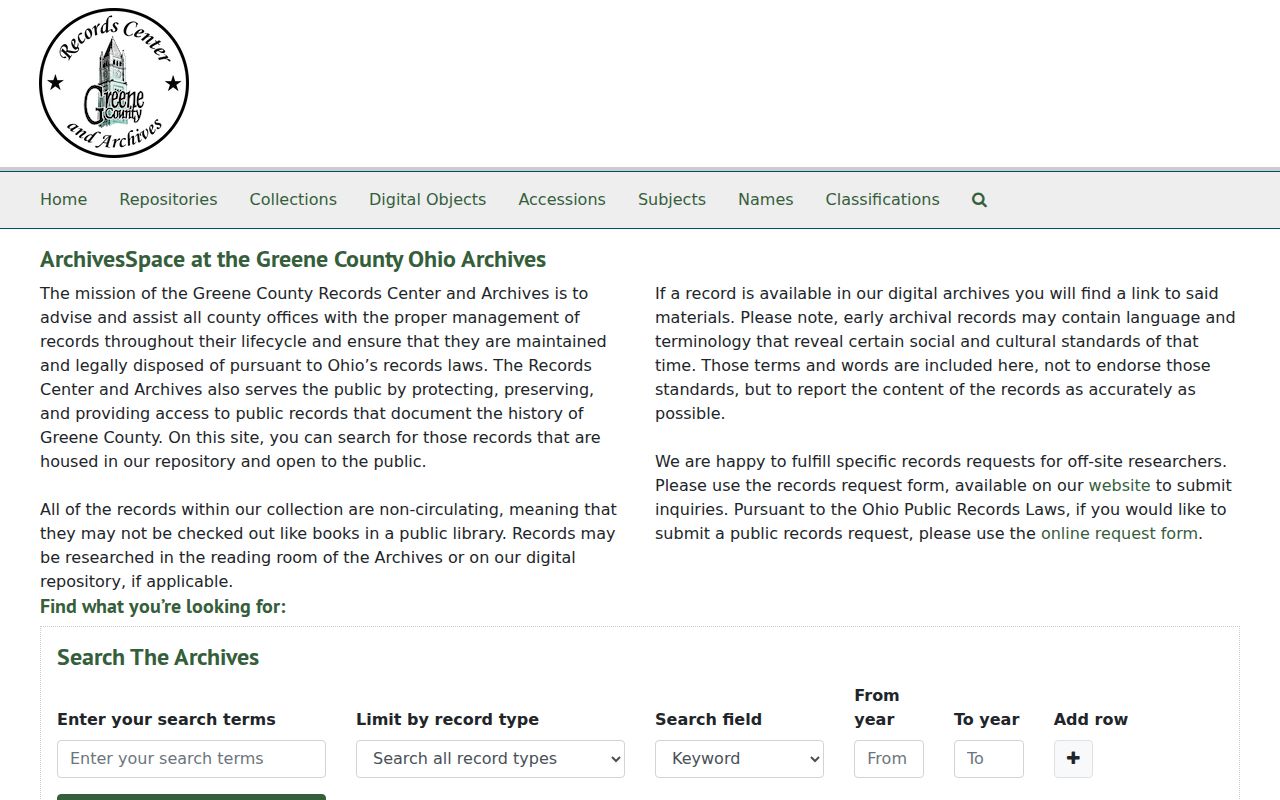
The catalog display is a discovery tool for a directory-era question, while the original item or its custodian remains the source to verify.
Fairborn Directory History
Fairborn's local story explains why a Fairborn historical directory search should follow both time and place. Greene County was established in 1803. County deed records extend from 1803, while transcribed deeds from 1804 to 1864 are held by the Archives. The library's Fairborn directory collection reaches to 1870 and newspaper microfilm to 1814. These are collection landmarks, not a claim that every year or name is online. Together, they show why a Fairborn web index is only one part of a historical search.
- 1814: Greene County Room newspaper microfilm begins.
- 1870: Greene County Room directories reach this early collection point.
- 1913: Original Osborn moved after flood and dam work.
- 1950: Fairfield and Osborn merged as Fairborn.
- 1984: The Recorder's online document index begins, leaving earlier work to historical channels.
This local history is the central interest point in the collection: an address trail can shift because the community moved and merged, even when the family did not. Do not rewrite that history as a courthouse-record loss. The research found no verified county courthouse fire or flood event that destroyed a defined set of resident records.
Fairborn Directory Companion Records
After a Fairborn directory find, the Greene County Room and Archives offer several ways to test the lead. Historic newspaper microfilm can add Fairborn date or local context. Cemetery records may provide inscriptions and family clues. Probate, family files, census schedules, and archival maps can clarify a Fairborn relationship or place when documented by the original source. Voices of Greene County and WYSO archive material add era context, including oral histories connected with local residents and the 1974 tornado. They are not proof of a living person's current address.
When a historic directory find needs present-day confirmation, use the county record suited to the question instead of stretching the old listing too far. A name-to-record check can continue through the Fairborn record lookup, while street-level and parcel questions belong with current county property sources. Keep the directory year, map year, and source citation together so another researcher can repeat the comparison.
Note: Library and archives materials can point to a household story, but the printed volume, map, or record copy should be cited for each factual claim.